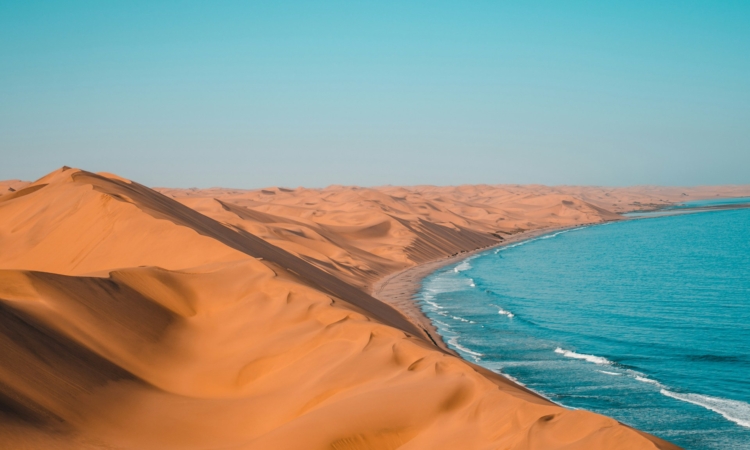

The Namib Desert is located on the west coast of southern Africa. It stretches more than 1,250 miles (2,000 kilometers) from the Olifants River in South Africa to the city of Namibe in Angola.
Most of the desert lies in the country of Namibia. The Atlantic Ocean borders the western part of the Namib. The Orange River cuts through the southern Namib on its way to the Atlantic.
Geography
The Namib Desert has scattered mountains, moving sand dunes, and gravel plains. Some of the sand dunes in the Namib are among the highest in the world, reaching up to 1,000 feet (300 meters).
Rain is very rare in the Namib. However, there is often heavy fog along the coast. The fog forms when cold air from the sea moves over the land. The sea breeze keeps the temperatures along the coast quite cool, usually between 50 to 60 °F (10 to 16 °C).
In areas where the sea breeze does not reach, temperatures rise much higher, often above 100 °F (38 °C).
Animals & Plants
The Namib Desert has different plant zones. Succulent plants grow near the coast. These are plants with thick leaves or stems that store water. They get moisture from the fog.
The western part of the Namib is very dry and has almost no plants. In the eastern part, some short grasses grow when it rains. In the south, there are more succulents and trees along the bigger streams.
Some sand dunes are covered with grass and small bushes. One of the strangest plants in the Namib is the welwitschia, also called tumboa. It has just two large leaves that grow along the ground.
These plants can live for over 1,000 years.
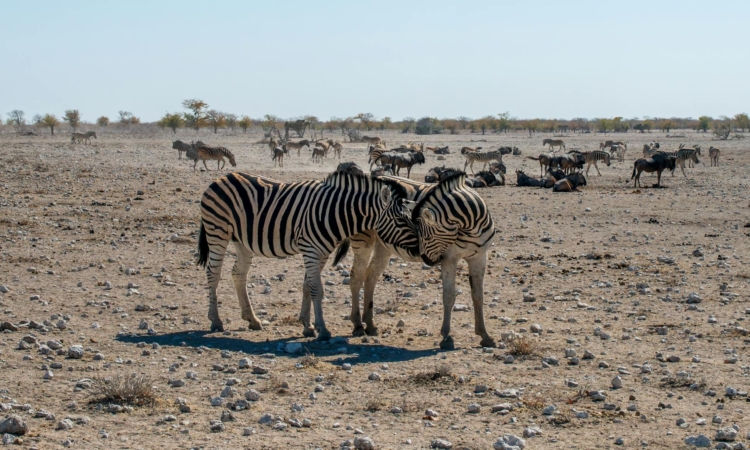
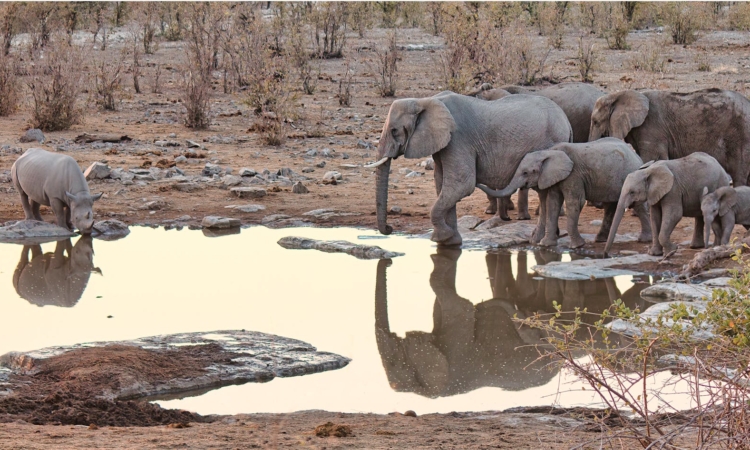
Animals found in the Namib include antelope, ostriches, zebras, elephants, rhinoceroses, lions, hyenas, and jackals. Many insects and reptiles like beetles, geckos, and snakes live in the dunes of the western Namib.
Settlement
The Namib Desert has very few people, except for some small settlements. The Khoisan were the first people to live in the area. They ate shellfish and built shelters using whale bones. These people are also known as Strandlopers.
Today, a small group of Himba people still live as nomads in the northwest part of the Namib. They move from place to place to find grass and water for their cattle and goats.
They build cone-shaped homes from branches, covered with mud and animal dung.
Minerals
The Namib Desert has many diamonds. The first diamond was found there in 1908. The Orange River carries diamonds down to the ocean. Some of these diamonds end up on the coast.
The Namib also has deposits of uranium and copper.